
Brief
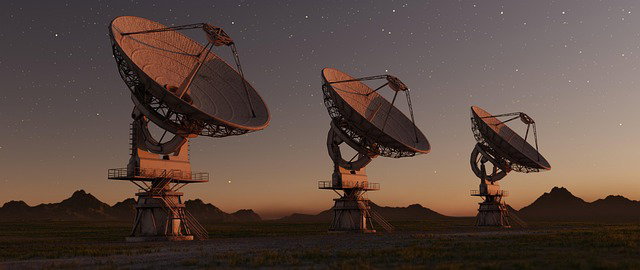
Science Defense Space Astronomy Tech Energy Physics Newsletter Submissions About (Image Credit: AdisResic/Pixabay) SETI Researchers Are Expanding the Search Beyond the ‘Water Hole’ Austin Burgess · July 31, 2026 Astronomers searching for extraterrestrial intelligence have traditionally focused on a specific, narrow band of the radio spectrum. However, a new survey presented at the Royal Astronomical Society ‘s National Astronomy Meeting (NAM2026) in Birmingham suggests that this approach may overlook a significant portion of the available frequencies . The frequencies most often investigated by SETI ( Search for Extraterrestrial Intelligence ) programs are those between 1.42 and 1.66 GHz. This range, known as the ‘water hole’, is situated between the natural radio emissions of hydrogen and hydroxyl, the two molecules that make up water . Astronomers have regarded this quiet section of the spectrum as a reasonable place for interstellar communication , because any civilization acquainted with these molecules would probably also decide to send and receive signals in search of in that specific region. Louisa Mason, who is carrying out research as a PhD student at the University of Manchester , focused on investigating frequencies outside the water hole range. To carry out the first SETI survey with that telescope, she used archived data from the Atacama Large Millimeter/submillimeter Array (ALMA) in Chile. She analyzed data originally collected for other astronomical studies instead of requesting new observation time. Hunting for Signals in Unclaimed Territory Mason focused on two narrow frequency bands in the ALMA Band 3 data, looking for narrowband signals that might be the result of technology rather than natural astrophysical origins. In the four observations that she examined, she did not discover any candidates for technosignatures above her detection threshold. “For decades, SETI searches have concentrated on a relatively small part of the radio spectrum. We wanted to ask what might happen if we looked somewhere very different,” Mason said. “The millimetre and submillimetre radio bands remain almost completely unexplored for SETI, so this is really about opening up a new area of parameter space to search.” A lack of results does not rule out the possibility of alien transmitters. It only means that none appeared in this specific region of the sky and frequency range. Mason describes the survey as a proof of concept, showing that high-frequency telescopes like ALMA could play a much larger role in future SETI efforts. A Much Bigger Haystack Than Anyone Realized The research also revealed a gap in how astronomers count the stars they have actually examined. Each time a telescope observes a single target, it also collects light from many other stars in the same field of view. Researchers refer to this as “stellar bycatch.” Previous SETI surveys have made this bycatch estimate based on the Gaia catalog, which is the European Space Agency ‘s survey of the stars. However, Gaia has certain limitations such as its magnitude cutoffs, uncertainties when measuring distant stars, and difficulties in crowded areas. To overcome these limitations, Mason used the Besançon Galactic Model, a simulation of the Milky Way’s stellar population that includes stars that are too faint or too far away for Gaia to detect. See Also Cornell Researchers Say New Wind and Solar Power Projects Could Profit from Bitcoin Mining When Mason applied the model to a previous survey of 1,327 telescope observations, the estimated number of stars observed increased from about 288,000 with Gaia to over 6.1 million with the galactic simulation. “One of the most exciting things about this work is realizing that we’ve surveyed many more stars than initially thought,” Mason said. “Even a very small observation can contain a huge number and diversity of stars that we might never have intended to study. By combining high-frequency observations with galactic simulations, we can better understand exactly what we’ve searched and where we should look next.” Recommendations for SETI Mason carried out this research in collaboration with Professor Michael Garrett, Dr. Andrew Siemion, and Dr. Kelvin Wandia. The team argues that expanding both the radio frequencies searched and the number of stars included could reduce the influence of human assumptions on SETI strategies. Whether these broader searches will detect technosignatures missed by traditional water-hole surveys remains unknown. Austin Burgess is a writer and researcher with a background in sales, marketing, and data analytics. He holds an MBA, a Bachelor of Science in Business Administration, and a data analytics certification. His work focuses on breaking scientific developments, with an emphasis on emerging biology, cognitive neuroscience, and archaeological discoveries. Previous Article Britain’s Power Grid Has a Blind Spot for Extreme Solar Storms, New Research Reveals Next Article “It’s Obviously Quite Over the Top”: We Talked to the Company Behind This Eerie Four-Legged “Centaur” Robot That’s Going Viral Related Posts Scientists Have a Plan to Detect Exotic Aliens, New Gamma Wave Glasses, and an Ancient Roman ‘Megastructure’ Resurfaces Newsletter Scientists Propose a New Test for Detecting Alien Life Unlike Anything on Earth Biology Breaking News SETI Space These Curious Ancient Greek Artifacts Have Extraterrestrial Origins—Why They Vanished 3000 Years Ago Remains a Mystery Archaeology Breaking News Rare Meteorite From New Jersey Roof Strike Offers New Clues to the Origins of Life Astronomy Breaking News Space © Copyright 2026 The Debrief. All Rights Reserved. The thoughts, views, and opinions expressed in articles on this site belong solely to the authors and do not necessarily reflect those of The Debrief, or of other groups or individuals featured on this site. ADVERTISE CONTACT ABOUT EDITORIAL GUIDELINES COPYRIGHT PRIVACY Send a News Tip The Intelligence Brief Get Our Newsletter Science Defense Space Astronomy Tech Energy Physics Newsletter Submissions About Type to search or hit ESC to close See all results
Original source
https://thedebrief.org/seti-researchers-are-expanding-the-search-beyond-the-water-hole/
Comments
No comments yet.
Sign in to comment.